There was a time when, if your grandmother gave you a handmade quilt, it was a valuable piece of property. You took care of it and maybe even treasured it. A quilter’s skill was valued by the community.
Then Walmart started selling blankets for $20. They’re not as nice as what Grandma made, but they’re $20. You can buy a bunch of blankets, and you throw them away when they get threadbare or stained.
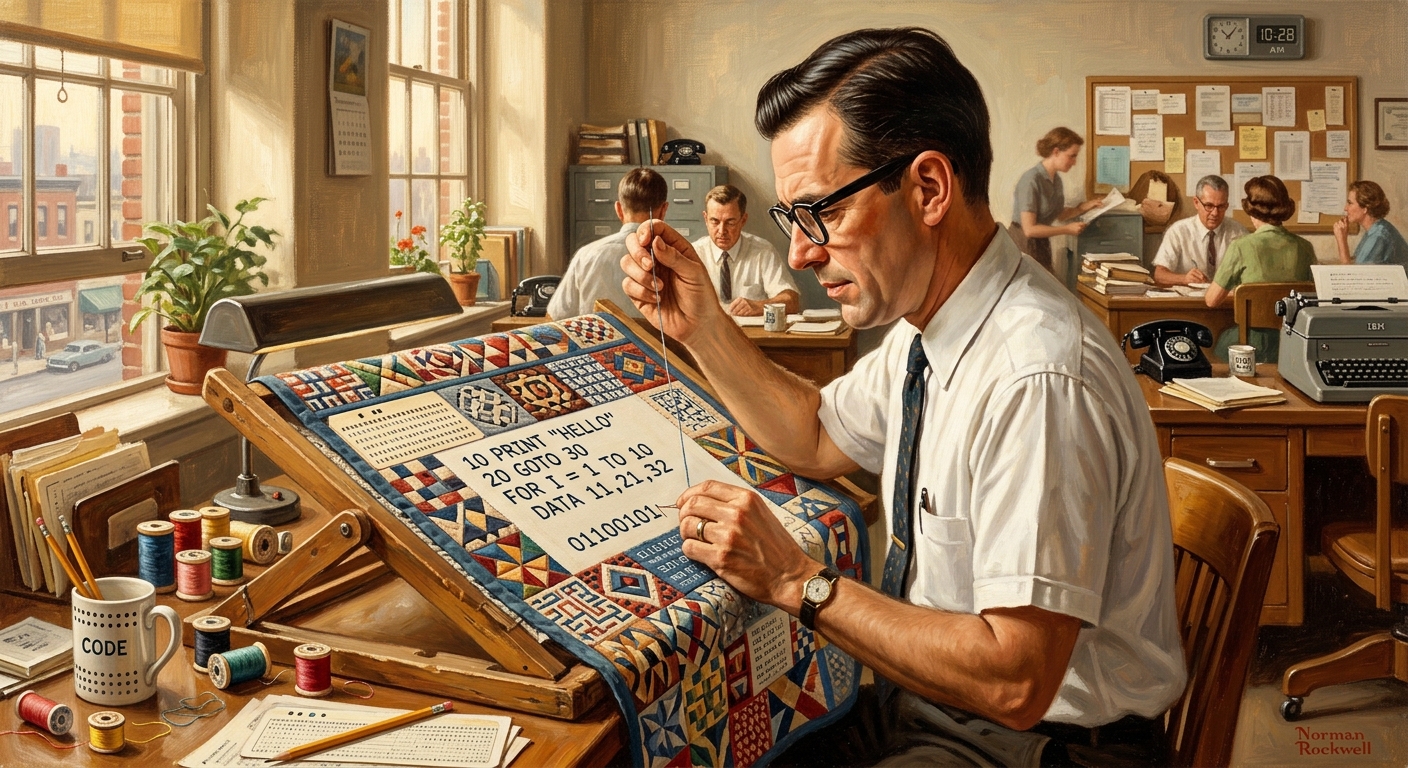
Image prompt
A detailed oil painting in the style of Norman Rockwell. A mid 30s, focused man with black rim glasses, wearing a tie and short sleeved white shirt. We view him from the side at his standard desk with an intricate quilt on a small wooden frame on top of the desk. He is meticulously stitching code into the quilt line by line using a needle and thread. The code is embroidered in a vintage 1950s monospace font. The quilt features patterns of geometric shapes and computer punch cards. The scene busy 1950 office with warm, soft sunlight from a side window. Expressive facial features, nostalgic Americana aesthetic, rich textures.
I could lament the fact that I used to write beautiful code—that my software was a piece of art meant to be maintained for years or decades. I could lament, but that’s not my point, and that’s not the problem I think tech is facing. I’m over the fact that my ability to write beautiful code is about as valuable as the ability to make a beautiful quilt. That is what machines do. That is what AI does.
The problem I think we’re really facing is… well, I’ll tell a story.
My youngest son was getting married, and we rented a large VRBO house for all of my family—seven kids, spouses, and grandchildren. That was a lot of people, and the house, while large and well-appointed, just didn’t have enough blankets.
So, I went to Walmart and bought three $20 blankets.
After the wedding, which was beautiful, it was time to go home. We packed up those blankets and brought them home. The problem was, our linen closet was full. I already had all the blankets I needed. I didn’t have a spot to store those extra blankets. Really, I probably should have just thrown them away, but they were good blankets and I had just bought them.
So… my wife looked at the linen closet and asked if we should throw away the quilt her grandmother made her.
And that is the problem we’re facing with AI coding.
It’s practically free to generate, so the impulse is, “Why not? Have it build that feature.” But cheap creation ignores the hidden tax: every line of code must be stored, audited, and maintained. We haven’t learned how to manage hundreds of bespoke programs, or how to triage what AI code is actually worth keeping.
I think our industry is going to have to get used to viewing code as disposable—like a $20 blanket.
In my own work with local AI, that means exploring a few practical questions:
- How do we design a staff of agents that actively decides what code to keep and what to throw away?
- How do we protect what actually has value—like tests and APIs—while letting the implementation be completely disposable?
I’ll let you know what I learn along the way.
Join the Discussion
- Discuss on X / Twitter
- Join the conversation on LinkedIn