When you leave Google, the first thing you lose is the illusion of infinite, free compute. Suddenly, every token has an invoice attached to it. Watching Steve Yegge burn $5,000 a month on Claude tokens for Wyvern was inspiring. I—alas—am not Steve Yegge, burning $5,000 a month on a video game with active players that I’ve been working on for 30 years. However, I did drop almost $5,000 on an ASUS Ascent GX10 to enable me to continue my AI learning without blowing my monthly budget on tokens.
I wanted a self-contained, portable, sovereign compute node rather than a giant rack in a server closet. Thus was born Suitcase AI—because the name reminds me of a suitcase nuke, so why not?
The general idea is a 10" minirack packed with the inference, storage, and general compute needed to handle real problems with a predictable cost: Unit 02 (the ASUS GX10 on top) dedicated to sovereign GPU inference, and Unit 01 (below) handling the control plane, hypervisor, and utility services.
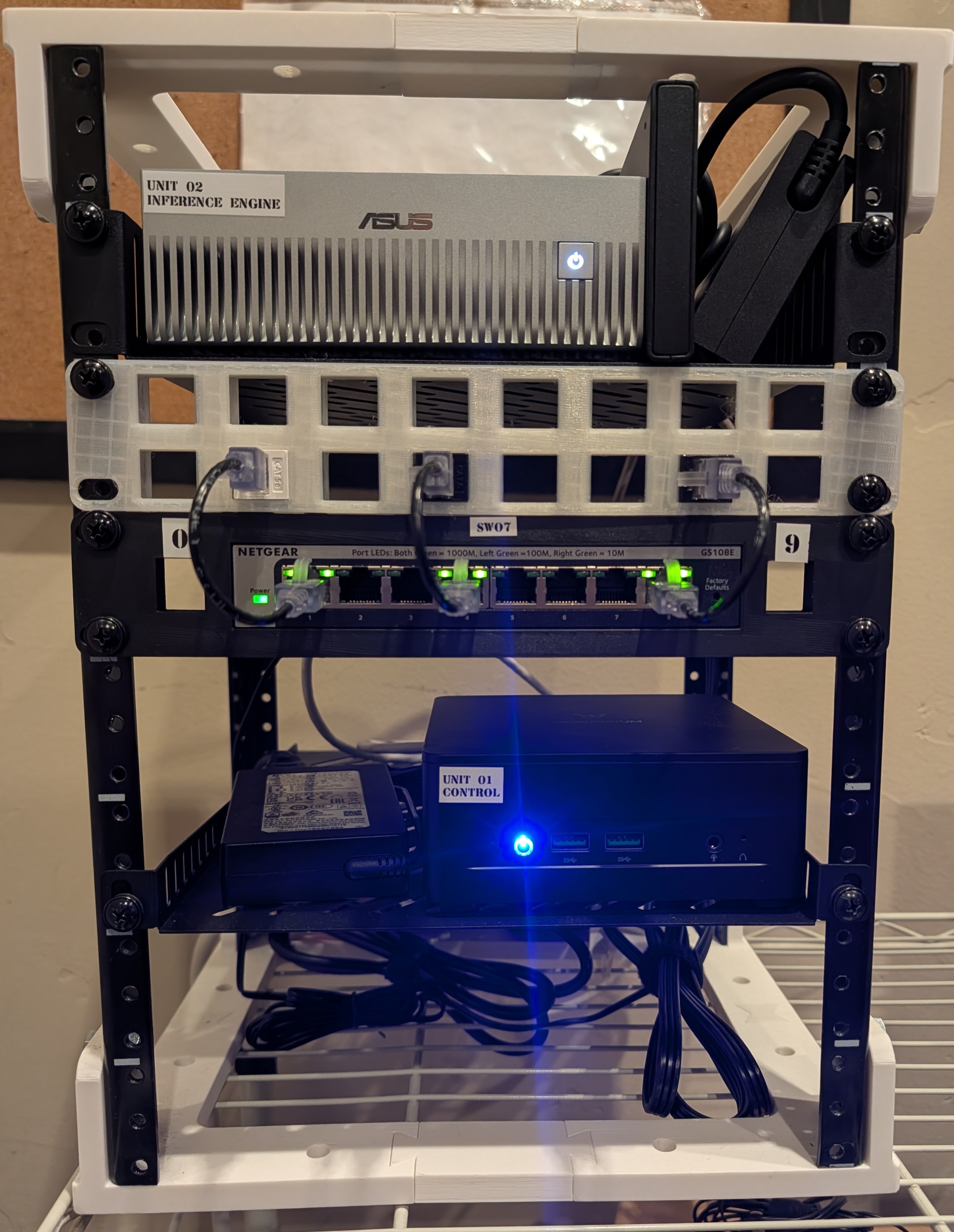
I spent several weeks just playing with different models and learning all kinds of things. For example, oh my gosh, the models are huge and take a long time to download—then as much as 10 minutes just to get the model loaded into memory! This means I really need to plan more instead of just trying something new because it’s there.
After three weeks of conflicting environments, orphaned model weight caches, and half-baked shell scripts, I finally decided I had made enough of a mess and started over with a clean, reproducible setup for Suitcase AI. My suitcase-ai repository is where all my infrastructure as code lives. Of course, I couldn’t resist using Kubernetes, Vault, and all the other tools required for a reasonable homelab. But I was putting more time into the infrastructure than actually learning about AI. The infrastructure is up, and I can now turn my attention back to AI.
The First Experiment: Hybrid Gas City
For my first experiment, I’m going to look at how I can use the Gas City harness with frontier models for human interaction, but rely on local models for the actual coding and other smaller tasks. I experimented with this previously and got stuck mostly on the watchdogs and other mechanisms needed to push things along; the smaller models seemed to get stuck on the simplest tasks.
In “Fences, Not Sandboxes,” Steve talked about how his agents wound up creating a large legal system to try and codify answers to previous mistakes. That kind of overhead will completely overwhelm local AI.
Steve was using all frontier models that have 200k+ context windows and unlimited cloud compute; they can act like medieval parliamentarians drafting bylaws. But a local model running on a maximum of 80GB of memory needs lean, deterministic instructions. If you bury a local model under a mountain of procedural “fences” and legal rules, it stalls under its own weight.
In fact, Steve later found that even Fable seemed to legislate itself into a corner.
Next week I will be back at it, and I’ll let you know which model I selected and how it worked on a sample task assigned to Gas City.
Join the Discussion
- Discuss on X / Twitter
- Join the conversation on LinkedIn